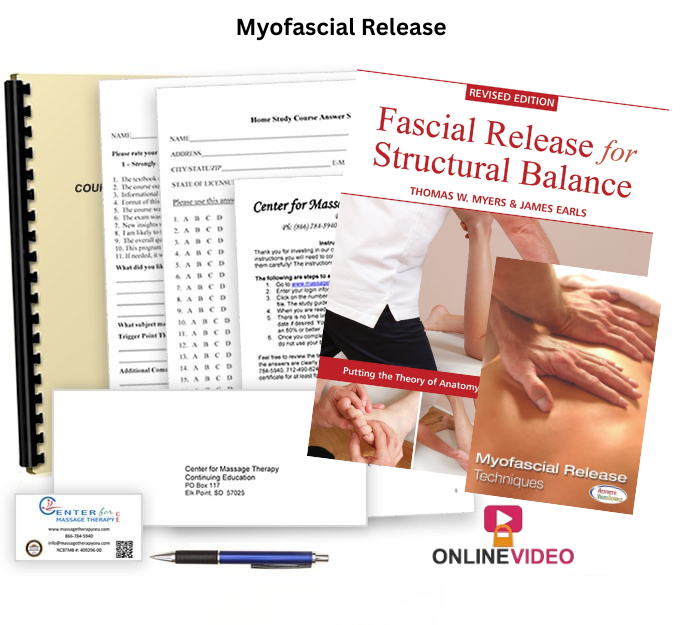
Cost includes all materials. Shipping, if applicable, is a flat rate.
Learn practical myofascial release (MFR) techniques in this 9-hour continuing education course for massage therapists. Based on the teachings of John F. Barnes, the course introduces the principles of myofascial release, fascial restrictions, client assessment, and hands-on techniques that can be incorporated into massage practice.
The course covers initial intake and assessment along with visual and palpation techniques used to evaluate fascial mobility, including fascial drag, end-feel, tissue bounce, and tissue glide. Techniques include cross-handed releases, plane releases, compression releases, scar tissue release, skin rolling, and myofascial mobilizations. The course also includes 52 minutes of online video demonstrations.
In this course, you will learn:
The principles and basic concepts of myofascial release
The fascial matrix and fascial restrictions
Initial intake and assessment considerations
Visual and palpation assessment techniques
Fascial drag, end-feel, tissue bounce, and tissue glide
Cross-handed, plane, and compression releases
Scar tissue release and skin rolling techniques
Myofascial mobilizations that can be incorporated into massage practice
Techniques demonstrated through 52 minutes of online video
Why take this course?
This course is a good choice for massage therapists who want practical instruction in myofascial release techniques. It combines assessment concepts with hands-on MFR techniques and video demonstrations, providing a focused introduction that can be incorporated into massage practice.
Explain the basic principles and concepts of myofascial release.
Describe the role of the fascial system and fascial restrictions in MFR.
Identify appropriate information to gather during an initial client intake and assessment.
Describe visual and palpation techniques used to assess fascial mobility.
Explain the purpose of fascial drag, end-feel, tissue bounce, and tissue glide assessments.
Describe several myofascial release techniques, including cross-handed, plane, and compression releases.
Identify techniques for scar tissue release, skin rolling, and myofascial mobilization.
Apply basic myofascial release principles and techniques within professional massage therapy practice.
Text: Myofascial Release, 2nd Edition, by Ruth Duncan, 248 pages
Approximately 1 hour of online myofascial release technique demonstrations
Study guide with instructions
52-question online multiple-choice exam
Course evaluation
Certificate of achievement upon completion
Unlimited phone support
The Center for Massage Therapy Continuing Education, LLC is an Approved Provider through the National Certification Board for Therapeutic Massage and Bodywork (NCBTMB); Approved Provider number 409296-00.
Our massage online continuing education courses are also accepted by the American Massage Therapy Association (AMTA), Associated Bodywork and Massage Professionals (ABMP), and most state boards.
For more information on individual state requirements and approvals, please visit our Approvals page and click on your state.
This was an excellent way to study and learn new technique. I especially appreciated the videos and the continued access as I practice to become proficient. - Susan J.
This course was so excellent. The wording in the text was very well done and then you have the pictures in the book and videos as well. Very well done. - Barb A.
Nice concise explanations of techniques in the book backed up with the short and clear video demos. The helpful tips. Good discussion of fascial in the first chapter. - Sharon H.
I absolutely loved everything about this class. I currently use some of these techniques in my practice but this just reinforces why I learned them and continue to use them. - Tami M.
Video and photo index are extremely helpful. The section on home programs, with photos is a great resource for me and my clients as well. Excellent book/course! - Shirley D.
The author was great. I have taken 4 myofascial release courses from John Barnes and I am extremely pleased with this course. - E. Williams
Why is fascia been described as the largest system in the human body?
A. Because it touches all other structures and is said to be involved in the experience of pain
B. Because it is a vast network of osseous tissue that innervates all bones, muscles, and organs of the body
C. Because it does not touch all other structures and is not involved in the experience of pain
D. Because it originates in the brain stem and branches out to all other structures in the human body
What is end-feel?
A. A term applied to the action of moving a joint through its entire range of motion, assessing for resistance
B. A term applied to gliding dysfunctional tissues along the path of least resistance until free movement is achieved
C. A term applied to anatomical structures at which the available range of motion of a joint or muscle meets resistance
D. A term applied to applying a repetitive, gentle bounce into the tissues once you reach the point of resistance
Direct scar tissue work, although beneficial, can be quite painful and will elicit a __________ sensation as the tissue changes.
A. Relieving
B. Cooling
C. Hardening
D. Burning
Course Author
About the Instructor
Corrine Rubida, BS, LMT
Corrine completed her massage therapy training at Gateway College of Massage Therapy in 1997 and earned a Bachelor of Science degree in Healthcare Administration in 2012. She has been practicing and teaching massage therapy since 1997 and currently holds a massage therapy license in South Dakota. She is also a member of the ABMP. In 2002, Corrine founded the Center for Massage Therapy CE to make professional massage continuing education courses available both online and by mail. Since then, she has developed more than 100 home-study massage continuing education courses and has taught live courses for AMTA and the Gateway College of Massage Therapy.