Cost includes all materials. Shipping, if applicable, is a flat rate.
Learn soft tissue therapy techniques for the lower limb in this 9-hour continuing education course for massage therapists. The course covers assessment and treatment approaches for the hip, buttock, thigh, knee, leg, ankle, and foot, with techniques for 31 common lower-limb conditions.
The course provides step-by-step instruction in massage, stretching, soft tissue release (STR), and trigger point release techniques. You’ll also learn how to assess lower-limb posture and measure the effectiveness of massage therapy approaches. Strengthening exercises are included for educational purposes to help explain injury, posture, and muscle weakness, with scope-of-practice considerations clearly addressed.
In this course, you will learn:
Assessment and soft tissue therapy for the lower limb
Anatomy and common conditions affecting the hip, buttock, thigh, knee, leg, ankle, and foot
Massage techniques for 31 common lower-limb conditions
Stretching techniques and applications
Soft tissue release (STR) techniques
Trigger point release techniques
Lower-limb postural assessment
Methods for measuring the effectiveness of treatment
Considerations for developing an appropriate treatment approach
Strengthening exercises and their relationship to injury, posture, and muscle weakness
Why take this course?
Lower-limb conditions are common concerns that massage therapists encounter in practice. Understanding how to assess the lower limb and apply appropriate soft tissue, stretching, STR, and trigger point techniques can expand your treatment options and help you better adapt sessions to individual client needs.
This 9-hour course provides a focused combination of assessment information and practical technique instruction covering 31 lower-limb conditions. It is a good choice for massage therapists who want to strengthen their knowledge of lower-limb massage and soft tissue therapy.
Identify common soft tissue conditions affecting the hip, buttock, thigh, knee, leg, ankle, and foot.
Describe assessment methods used when evaluating lower-limb conditions.
Explain basic principles of soft tissue therapy for the lower limb.
Identify appropriate massage techniques for common lower-limb conditions.
Describe stretching techniques that may be incorporated into massage sessions.
Identify soft tissue release (STR) techniques and their applications.
Describe trigger point release techniques for lower-limb conditions.
Explain basic methods for assessing lower-limb posture.
Describe ways to evaluate the effectiveness of massage therapy approaches.
Recognize scope-of-practice considerations when discussing strengthening exercises or other client recommendations.
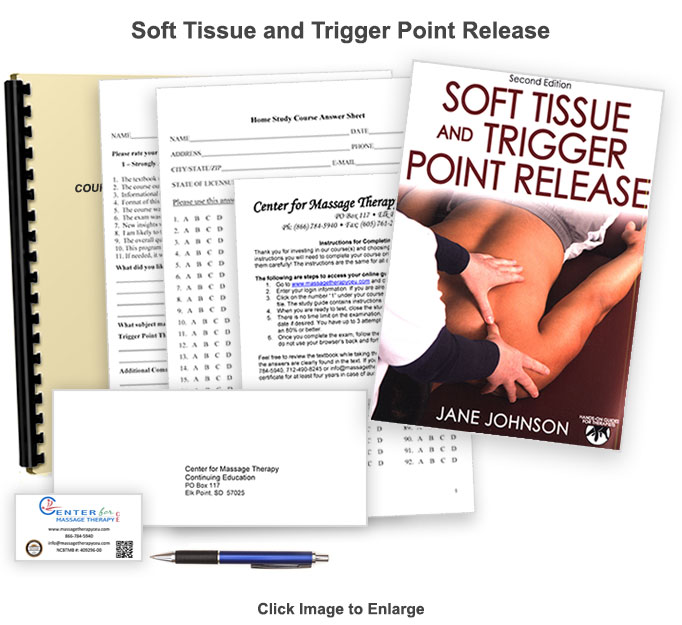
Text: Soft Tissue Therapy for the Lower Limb by Jane Johnson, 272 pages
Course guide with instructions
48-question multiple-choice examination
Course evaluation
Certificate of achievement upon completion
Unlimited phone and email support for any questions
The Center for Massage Therapy Continuing Education, LLC is an Approved Provider through the National Certification Board for Therapeutic Massage and Bodywork (NCBTMB); Approved Provider number 409296-00.
Our massage online continuing education courses are also accepted by the American Massage Therapy Association (AMTA), Associated Bodywork and Massage Professionals (ABMP), and most state boards.
For more information on individual state requirements and approvals, please visit our Approvals page and click on your state.
Informative & concise. New information was included that I could apply immediately. - Rabiah P.
I generally enjoy all the courses so far. Thank you. - Lisa B.
I liked the fact that I could download the textbook as many times ass I need. It made it easy to complete a little at a time. I also liked that you can save your answers and return to finish your exam. Steve P., LMT
If you determine that the left and right PSIS should be positioned on the same horizontal plane, yet you observe one to be higher, what does this suggest?
A. That the pelvis is laterally tilted
B. That the pelvis is rotated
C. That the pelvis is neutral
D. That the pelvis is tilted upwards
Which of the following is NOT a factor corresponding to a posterior pelvic tilt?
A. Position of the ASIS: held posterior to the pubis
B. Corresponding position of the lumbar spine: increased lordosis
C. Shortened muscles: lower abdominals, gluteus maximus
D. Lengthened muscles: lumbar erector spinae, psoas, iliacus, rectus femoris
Where does the gluteus maximus trigger point cause pain?
A. In the sacrum and up into the medial spine and quadratus lumborum
B. Along the sacroiliac joint and into the base of the buttock on that side
C. In the buttock and lateral thigh and leg on that side
D. Along the sacroiliac joint and into the lateral aspect of the tensor fasciae latae
Which of the following are appropriate massage techniques to use after knee surgery?
A. Friction and petrissage applied superior to the knee itself
B. Effleurage or manual lymphatic drainage applied superior to the knee itself
C. Friction and petrissage applied inferior to the knee itself
D. Effleurage or manual lymphatic drainage applied inferior to the knee itself
Which of the following can be used to both test and improve balance?
A. The seated leg raiser test
B. The supine leg raiser test
C. The single-leg standing exercise
D. The double-leg standing exercise
Course Author
About the Instructor
Jane Johnson, PhD, MSc, BSc(Hons), BA(Hons), CSP, HCPC
Jane Johnson, PhD, MSc, BSc(Hons), BA(Hons), CSP, HCPC, is a chartered physiotherapist specializing in occupational health and massage. In this role she assesses the posture of clients; performs manual assessments, including that of the soft tissues; and determines whether work, sport, or recreational postures may be contributing to a person’s symptoms. She devises postural correction plans that include both hands-on and hands-off techniques. A key element of her work involves educating each client in how to self-manage their condition.