Cost includes all materials. Shipping, if applicable, is a flat rate.
Learn the fundamentals of ligament sprains and explore massage therapy considerations for clients experiencing symptoms associated with a sprain. This 1-hour continuing education course introduces massage therapists to the different types of ligament sprains, common signs and symptoms, contributing factors, contraindications, assessment techniques, massage strategies, and client self-care.
Whether you regularly work with clients recovering from injuries or simply want to expand your knowledge of condition-specific massage, this course provides a focused introduction to assessing and working with clients experiencing ligament sprains.
In this course, you will learn:
What a ligament sprain is and how it affects the body
Different types of ligament sprains
Common signs, symptoms, and contributing factors
Contraindications and special considerations
Client assessment techniques, including relevant questions and range-of-motion testing
Massage techniques and strategies appropriate for ligament sprains
Considerations for modifying massage based on the client's condition
Client self-care strategies, including stretching and strengthening
Why take this course?
Understanding ligament sprains and appropriate massage therapy considerations can help massage therapists make more informed decisions when working with clients who have experienced an injury. Recognizing contraindications, assessing the client, and selecting appropriate techniques are important parts of responsible condition-specific massage.
This focused 1-hour course provides a convenient introduction to ligament sprains, assessment, massage strategies, and self-care. It is a useful option for massage therapists who want to strengthen their knowledge of common injuries or add a short condition-specific course to their continuing education.
Define ligament sprains and identify common types of sprains.
Identify common signs, symptoms, and contributing factors associated with ligament sprains.
Recognize contraindications and special considerations when working with clients experiencing a ligament sprain.
Apply basic client assessment techniques, including relevant questions and range-of-motion testing.
Identify appropriate massage techniques and treatment strategies for ligament sprains.
Describe client self-care strategies, including stretching and strengthening.
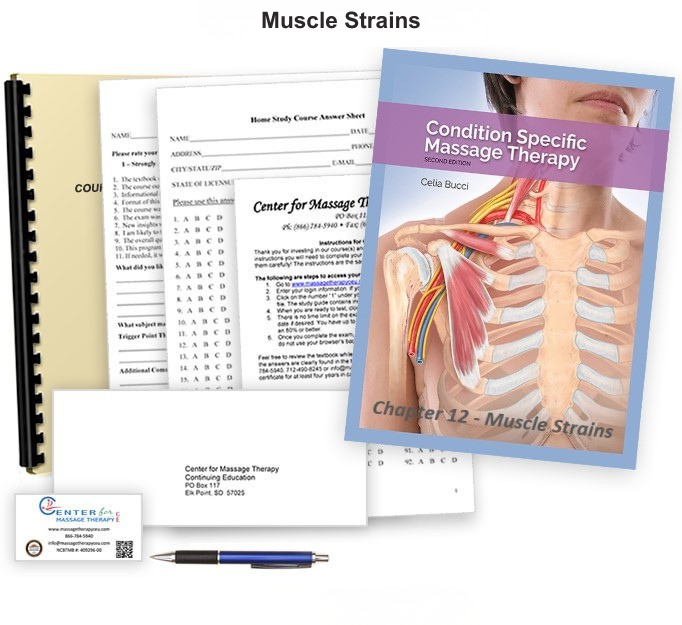
Text: Ligament Sprains, an excerpt from Condition-Specific Massage by Celia Bucci, 25 pages
Course instruction guide
9-question multiple-choice final exam
Course evaluation
Certificate of Achievement upon completion
Unlimited phone support for course-related questions
The Center for Massage Therapy Continuing Education, LLC is an Approved Provider through the National Certification Board for Therapeutic Massage and Bodywork (NCBTMB); Approved Provider number 409296-00.
Our massage online continuing education courses are also accepted by the American Massage Therapy Association (AMTA), Associated Bodywork and Massage Professionals (ABMP), and most state boards.
For more information on individual state requirements and approvals, please visit our Approvals page and click on your state.
I learned things I did not know and it was enjoyable! - Bruce B.
Great information in an easy to access format. Highly recommend. - Marietta G.
Wish I had found your website sooner! Love all of the courses, so easy to follow! - Jenaire Y.
Very informative and easy to follow. I enjoyed taking this course and found it very helpful. - Lesley H.
What is the most common cause of a sprain?
A. A slow, gradual overstretching of a ligament beyond its capacity
B. An overstretching of a ligament beyond its capacity over time caused by repetitive motions
C. A swift, high-impact movement that stretches the ligament beyond its capacity
D. Beginning a new activity following a period of inactivity without gradual reconditioning
Which of the following is effective for gradually restoring strength to weakened muscles?
A. Pain-free, passive ROM
B. Pain-free, resisted ROM
C. Pain-free, active ROM
D. Pain-free, weight-bearing activities
Longitudinal strokes should be applied:
A. Directly on top of the tear
B. Never, only cross-fiber strokes should be used on strains
C. To the full length of the injured muscle
D. Proximal to the injured muscle
Course Author
About the Instructor
Celia Bucci, LMT
Celia graduated from the Soma Institute for Clinical Massage Therapy in 2002. Her continuing education has focused on learning what contributes to common pain complaints, methods for reducing pain and improving movement, and the research supporting both. She’s taught in entry-level massage therapy schools and continuing education programs. She wrote Condition Specific Massage Therapy for massage therapists interested in learning to apply basic techniques to address the specific symptoms of conditions such as headaches, neck, shoulder, low back, hip and knee pain, carpal tunnel syndrome, plantar fasciitis, sprains, muscle strain and tendinitis. The book is used in Massage Therapy schools across the country and is available in Japanese and Korean. Celia has received the 2010 AMTA-IL Distinguished Service Award and the 2012 AMTA-IL Meritorious Award.