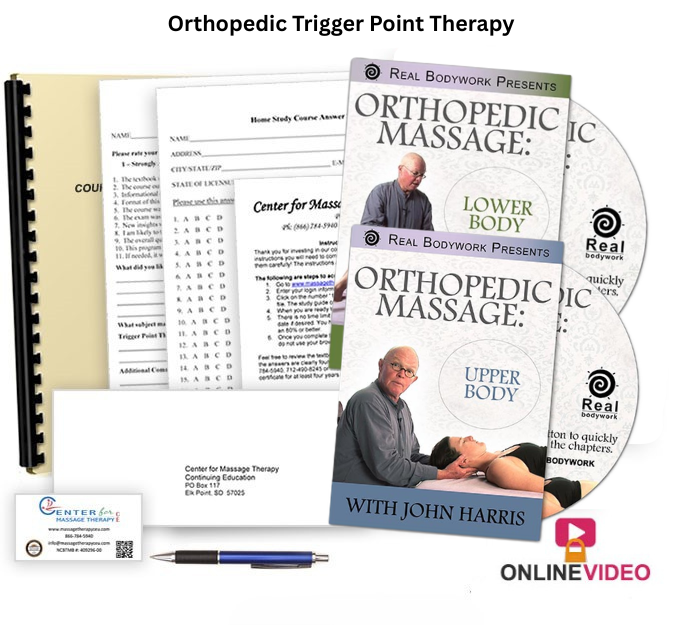
Cost includes all materials. Shipping, if applicable, is a flat rate.
Develop your knowledge of orthopedic massage and learn massage therapy approaches for common soft tissue injuries and musculoskeletal conditions in this 17-hour continuing education course. The course introduces the principles and components of orthopedic massage and explores conditions that may result from work, sports, accidents, and other activities.
The course covers orthopedic conditions affecting the foot, ankle, leg, knee, hip, pelvis, spine, neck, shoulder, arm, wrist, and hand. It also explores massage techniques, traditional treatment approaches, physiological effects of massage, and thermal applications used as treatment aids for soft tissue injuries.
In this course, you will learn:
The principles, theory, and components of orthopedic massage
Common soft tissue injuries and musculoskeletal conditions
Orthopedic conditions affecting different regions of the body
Massage approaches for sprains, strains, tendon conditions, and other injuries
Assessment and treatment considerations for common orthopedic conditions
Physiological effects of massage techniques on the body
Active and passive movement, myofascial approaches, and stretching methods
Thermal applications, including heat and cold, for soft tissue injuries
Treatment considerations for conditions involving the spine, shoulder, hip, knee, ankle, and upper extremities
Why take this course?
Orthopedic conditions are common among clients with work-related, sports-related, and everyday injuries. This 17-hour course provides a broad foundation in orthopedic massage, covering conditions throughout the body along with massage strategies, physiological effects, movement approaches, and thermal applications.
Define orthopedic massage and describe its primary components.
Identify common types of soft tissue and musculoskeletal injuries addressed in orthopedic massage.
Describe orthopedic conditions affecting different regions of the body.
Explain massage therapy considerations for common sprains, strains, and other orthopedic conditions.
Describe the physiological effects of massage techniques on the body.
Explain the role of active and passive movement, myofascial approaches, and stretching methods.
Identify appropriate considerations for the use of heat and cold with soft tissue injuries.
Apply knowledge of orthopedic massage principles and treatment strategies within professional massage therapy practice.
Text: Orthopedic Massage by Whitney W. Lowe, 312 pages
Study guide with instructions
104-question online multiple-choice exam
Course evaluation
Certificate of achievement upon completion
Unlimited phone support
The Center for Massage Therapy Continuing Education, LLC is an Approved Provider through the National Certification Board for Therapeutic Massage and Bodywork (NCBTMB); Approved Provider number 409296-00.
Our massage online continuing education courses are also accepted by the American Massage Therapy Association (AMTA), Associated Bodywork and Massage Professionals (ABMP), and most state boards.
For more information on individual state requirements and approvals, please visit our Approvals page and click on your state.
This course helped me understand more about orthopedic injuries and valuable treatment techniques. The course went beyond just explaining what techniques to use; it actually described the physiological effects of the treatment, which I feel is important to understand. - Sharon Leake, LMT
Very interesting and informative. - R. Creson, LMT
I liked the discussions on treatments. - A. Kramer, LMT
I like that I have the book to fall back on as a reference and can use it anytime I wish. It is clear and easy to follow and well written. - B. Schulz, LMT
I very much enjoyed learning how to help clients with injuries or issues that are very specific. - Michelle P.
Which of the following type of muscle contraction is the most common cause of muscular injury?
A. Concentric
B. Isometric
C. Eccentric
D. Neutral
Active-assisted stretching uses a variety of stretching techniques which are based on the neurological principles of:
A. Active release technique (ART)
B. Muscle energy technique (MET)
C. Post isometric relaxation (PIR)
D. Active isolated stretching (AIS)
What is the primary focus of massage when treating torticollis?
A. To stabilize the central nervous system
B. To reduce the chronic muscle spasms that occur
C. To increase the chronic muscle spasms that occur
D. To increase edema in the surrounding tissues
Course Author
About the Instructor
Corrine Rubida, BS, LMT
Corrine completed her massage therapy training at Gateway College of Massage Therapy in 1997 and earned a Bachelor of Science degree in Healthcare Administration in 2012. She has been practicing and teaching massage therapy since 1997 and currently holds a massage therapy license in South Dakota. She is also a member of the ABMP. In 2002, Corrine founded the Center for Massage Therapy CE to make professional massage continuing education courses available both online and by mail. Since then, she has developed more than 100 home-study massage continuing education courses and has taught live courses for AMTA and the Gateway College of Massage Therapy.