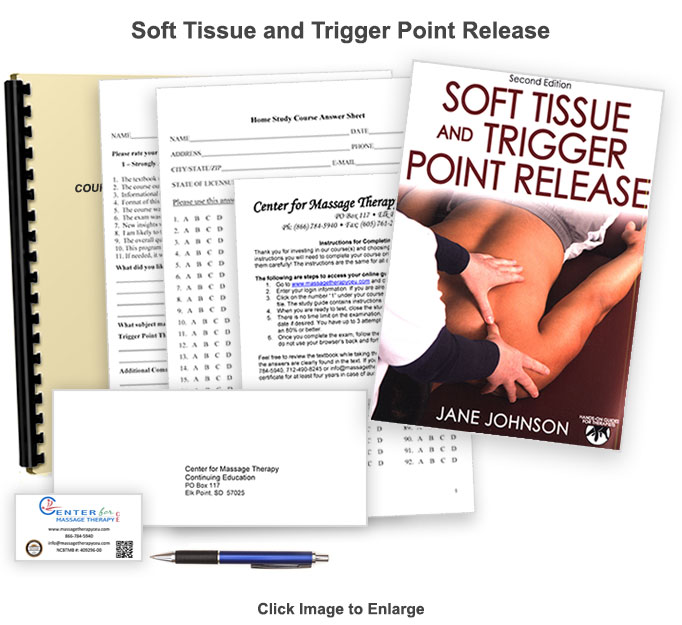
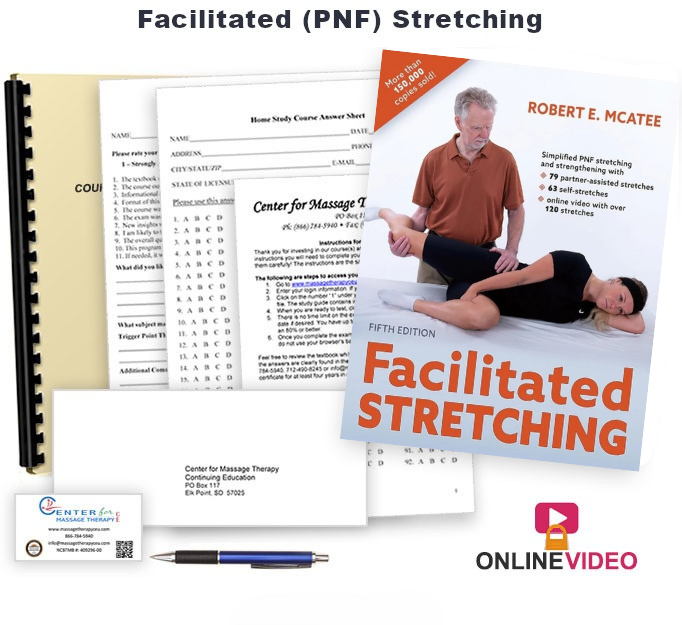
Cost includes all materials. Shipping, if applicable, is a flat rate.
Learn the principles and practical application of muscle energy techniques (METs) in this 8-hour continuing education course. METs use gentle isometric contractions as part of a soft tissue approach to help relax and lengthen muscles. This course introduces massage therapists to how METs work, how they are performed, and how they can be incorporated into massage practice.
The course covers muscle anatomy, assessment techniques, range-of-motion testing, indications and contraindications, and MET applications for different areas of the body. Approximately 1½ hours of online video demonstrations provide additional instruction in the techniques presented.
In this course, you will learn:
The history, principles, and effects of muscle energy techniques
How isometric contractions are used in MET
Muscle origins, insertions, innervation, and actions
Assessment techniques and range-of-motion testing
Indications and contraindications for MET
MET techniques for different areas of the body
Whole-body applications of muscle energy techniques
Practical techniques demonstrated through approximately 1½ hours of online videos
Why take this course?
Muscle energy techniques can be a useful addition to a massage therapist's skill set. This course combines anatomy and assessment information with practical MET instruction and approximately 1½ hours of online technique demonstrations, providing a solid foundation for incorporating these techniques into massage practice.
Describe the history, principles, and basic effects of muscle energy techniques.
Explain how isometric contractions are used in muscle energy techniques.
Identify the origin, insertion, innervation, and action of muscles addressed in the course.
Describe assessment techniques and range-of-motion testing used with MET.
Identify indications and contraindications for performing muscle energy techniques.
Demonstrate an understanding of MET applications for different areas of the body.
Explain whole-body applications of muscle energy techniques.
Apply course concepts when selecting and performing appropriate MET techniques within professional scope of practice.
Text: Muscle Energy Techniques by John Gibbons, 174 pages
Approximately 1½ hours of online technique videos
Study guide with instructions
40-question online multiple-choice exam
Course evaluation
Certificate of achievement upon completion
Unlimited phone support
The Center for Massage Therapy Continuing Education, LLC is an Approved Provider through the National Certification Board for Therapeutic Massage and Bodywork (NCBTMB); Approved Provider number 409296-00.
Our massage online continuing education courses are also accepted by the American Massage Therapy Association (AMTA), Associated Bodywork and Massage Professionals (ABMP), and most state boards.
For more information on individual state requirements and approvals, please visit our Approvals page and click on your state.
I liked the ability to order the physical materials, I enjoy having a book to read and refer back to. I also enjoyed being able to test online! The course was very challenging and informative! - Amanda E.
I like the fact that YouTube videos were included. - M. Leatherwood
The website was easy to navigate and the course was straight forward. It was full of useful information! - Geri Petrick
So many new stretching techniques that I can incorporate into my practice immediately. - James Woods
Customer service is wonderful and the course was full of relevant information. I liked how I can preview the exam before taking it online. - Maryann Butler
I liked the information and that the exam is not timed and I could save my answers and finish at a later date! - Traci Torrez
What is an isometric contraction? A. When there is increased tension in a muscle, but its length remains unchanged B. When the muscle attachments move closer together causing movement at the joint C. When a contraction which produces movement is assisted by someone else D. When the muscle fibers ‘pay out’ in a controlled manner to slow down movements
In the assessment of the trapezius muscle, which of the following is considered normal range of motion? A. 25 degrees B. 45 degrees C. 50 degrees D. 60 degrees
In the PIR method of MET treatment of subscapularis, which of the following is the correct patient action? A. Contraction of the subscapularis by internal rotation of the shoulder B. Contraction of the subscapularis by external rotation of the shoulder C. Contraction of the subscapularis by adduction of the shoulder D. Contraction of the subscapularis by abduction of the shoulder
Course Author
About the Instructor
John Gibbons, DO
John Gibbons is a registered osteopath with the General Osteopathic Council in the UK. He works with elite-level athletes in a range of sporting disciplines and serves as osteopath to the Oxford University Boat Club rowing team. An international lecturer in the fields of sports medicine and physical therapy, he offers advanced training in his Bodymaster Method, a unique fusion of therapy techniques that approaches the body as a complex integrated unit. The author lives in Oxford, England.