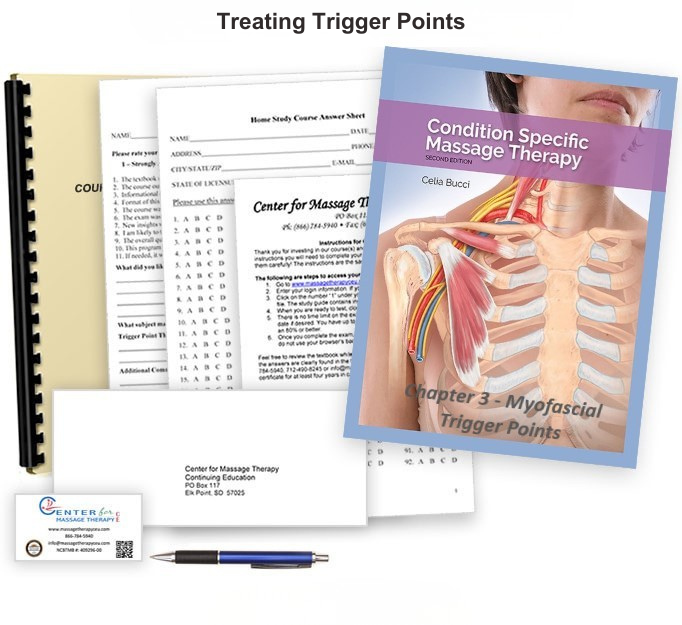
Cost includes all materials. Shipping, if applicable, is a flat rate.
Learn orthopedic trigger point therapy techniques in this 6-hour continuing education course for massage therapists. This video-based course explores common trigger points, referred pain patterns, muscle anatomy, palpation, and techniques for applying trigger point therapy to areas of the body affected by pain and injuries.
The course demonstrates static pressure, pincer palpation, friction techniques, and stretching approaches, including contract-relax-contract, post-isometric relaxation, and active stretching. Approximately 5½ hours of online video provide detailed demonstrations of muscles, common injuries, trigger point patterns, palpation, treatment applications, and client self-care.
In this course, you will learn:
The principles of an orthopedic trigger point therapy approach
Common trigger points and referred pain patterns
Muscle anatomy and trigger point locations
Palpation techniques for identifying muscles and trigger points
Static pressure, pincer palpation, and friction techniques
Contract-relax-contract and post-isometric relaxation techniques
Active stretching techniques for different areas of the body
Massage considerations for common muscle injuries
At-home self-care and stretching strategies
Approximately 5½ hours of online video demonstrations
Why take this course?
This course provides focused, video-based instruction in orthopedic trigger point therapy. With approximately 5½ hours of demonstrations, it combines trigger point anatomy, referred pain patterns, palpation, treatment techniques, stretching, and self-care in a practical format for massage therapists.
Explain the basic principles of an orthopedic trigger point therapy approach.
Identify common trigger points and their associated referred pain patterns.
Describe muscle anatomy and the location of common trigger points.
Explain palpation methods used to identify muscles and trigger points.
Describe static pressure, pincer palpation, and friction techniques.
Explain contract-relax-contract, post-isometric relaxation, and active stretching techniques.
Identify massage therapy considerations for common muscle injuries.
Describe appropriate stretching and self-care strategies related to trigger point therapy.
Text: Orthopedic Trigger Point Therapy video outline by Corrine Rubida, 16 pages
Video: Orthopedic Massage with John Harris, published by Real Bodywork, approximately 5 hours 30 minutes
Study guide with instructions
30-question online multiple-choice exam
Course evaluation
Certificate of achievement upon completion
Unlimited phone support
The Center for Massage Therapy Continuing Education, LLC is an Approved Provider through the National Certification Board for Therapeutic Massage and Bodywork (NCBTMB); Approved Provider number 409296-00.
Our massage online continuing education courses are also accepted by the American Massage Therapy Association (AMTA), Associated Bodywork and Massage Professionals (ABMP), and most state boards.
For more information on individual state requirements and approvals, please visit our Approvals page and click on your state.
I loved having the video available any time. I could stop and come back to it. - Penny K.
Great video-based course. Help me see the techniques being performed. I really enjoyed it. - Cheryl B., LMT
Was able to access this course immediately after purchasing. It was easy to understand and complete. Very organized. - Brittan M., LMT
Where do trigger points often reside in the masseter muscle?
A. The attachment site on the zygomatic bone
B. The leading edge toward the ear
C. The leading edge toward the mouth
D. The attachment site on the mandibular angle
Which of the following is a good tool for working the latissimus dorsi?
A. Direct pressure
B. Stretching
C. Pincer palpation
D. Transverse friction
Deep transverse friction across the hamstrings’ attachment site on the ischial tuberosity in cases of tendinosis:
A. Creates ischemic fibers, grows new tissue, and forms scar tissue
B. Creates procollagen fibers, grows new tissue, and breaks off scaring
C. Creates procollagen fibers, inflames tissue, and breaks off scar tissue
D. Creates broken fibers, grows new tissue, and forms scar tissue
Course Author
About the Instructor
Sean Riehl, CMT
Sean Riehl, CMT is the founder of Real Bodywork and a leading expert in massage therapy and bodywork education. A pioneer in clinical instruction, Sean began teaching massage in 1991, and has authored numerous textbooks and produced over 30 instructional videos used by massage schools and practitioners worldwide.
Beyond his clinical and educational work, Sean has been a driving force in the wellness industry’s growth. In 2022, he was a founding member of iFlex Stretch Studios, a premier assisted stretching franchise. Following the acquisition of iFlex by the founders of StretchLab in late 2024, Sean served as the Vice President of Training through 2025. In this role, he worked closely with the executive team to elevate training standards and curriculum for hundreds of practitioners before retiring from the position at the end of the year to focus on his educational legacy.

.png)