Cost includes all materials. Shipping, if applicable, is a flat rate.
Learn the fundamentals of postural correction and explore massage therapy techniques for addressing common postural misalignments. This 8-hour continuing education course introduces massage therapists to 30 common postural conditions, including neck flexion, kyphosis, lordosis, scoliosis, pelvic tilt, hip rotation, and elevated shoulders.
The course explains how to assess common postural conditions and provides techniques that may be used to support postural correction, including deep tissue massage, passive stretching and lengthening, soft tissue release, trigger point therapy, and traction. Client self-help strategies and referral considerations are also included.
In this course, you will learn:
The benefits, contraindications, and considerations of postural assessment and correction
30 common postural conditions and misalignments
Common causes of postural misalignments
The five steps to postural correction
Assessment considerations for common postural conditions
Massage techniques used for postural correction
Deep tissue, stretching, soft tissue release, and trigger point techniques
Traction techniques and other approaches to postural correction
Client self-help and posture strategies
When referral to another healthcare professional may be appropriate
Why take this course?
Postural imbalances are common concerns that massage therapists may encounter when working with clients. Understanding common postural patterns and the muscles and structures involved can provide useful information for assessment and massage therapy planning.
This 8-hour course combines postural assessment information with practical correction techniques and client self-help strategies. It is a good choice for massage therapists who want to move beyond identifying postural patterns and develop a stronger understanding of approaches used to address them.
Explain the benefits and considerations of postural assessment and correction.
Identify 30 common postural conditions and misalignments.
Describe common causes of postural misalignments.
Explain the five steps involved in postural correction.
Identify appropriate massage techniques for common postural conditions.
Describe stretching, soft tissue, trigger point, and traction techniques used in postural correction.
Identify client self-help strategies for supporting improved posture.
Recognize situations in which referral to another healthcare professional may be appropriate.
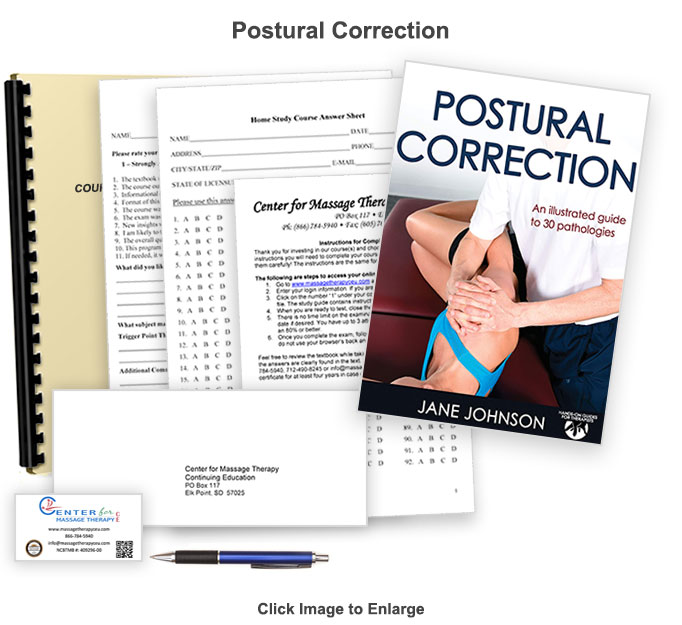
Text: Postural Correction by Jane Johnson, 232 pages
Course guide with instructions
57-question examination
Course evaluation
Certificate of achievement upon completion
Unlimited phone support
The Center for Massage Therapy Continuing Education, LLC is an Approved Provider through the National Certification Board for Therapeutic Massage and Bodywork (NCBTMB); Approved Provider number 409296-00.
Our continuing education courses are also accepted by the American Massage Therapy Association (AMTA), Associated Bodywork and Massage Professionals (ABMP), and most state boards.
For more information on individual state requirements and approvals, please visit our Approvals page and click on your state.
The textbook 'Postural Correction' by Jane Johnson was excellent, well-presented, and highly informative. The course test questions were also well chosen and varied across the pathologies covered in the text. Overall, a valuable and rewarding course. - Paula M.
Enjoyed the in depth information in the book. Followed with great pictures as a visual. - C. McIlwain
Very clear information presented in a well organized format. I learned things I can use right away! - J. McPhearson
I like that this course was all about how to correct postural problems. Gave me some great information to use right away! - Johanna Resis
Very thorough coverage of the research regarding each condition as well as the limitations to current knowledge. An excellent resource. - L. Hanson
All of the following are contraindications or require special caution to postural correction EXCEPT:
A. Inflammatory conditions
B. Acute thrombosis or embolism
C. When the treatment may help the healing process of any condition
D. Where the application causes pain
Which of the following muscles may be shortened in cases of a cervical spine laterally flexed to the right?
A. Left levator scapulae
B. Left scalenes
C. Right scalenes
D. Left sternocleidomastoid
In an anterior pelvic tilt, the anterior superior iliac spine (ASIS) falls __________ to the pubic bones in the sagittal plane unlike the neutral pelvic posture when these points are aligned.
A. Posterior
B. Lateral
C. Anterior
D. Medial
Course Author
About the Instructor
Jane Johnson, PhD, MSc, BSc(Hons), BA(Hons), CSP, HCPC
Jane Johnson, PhD, MSc, BSc(Hons), BA(Hons), CSP, HCPC, is a chartered physiotherapist specializing in occupational health and massage. In this role she assesses the posture of clients; performs manual assessments, including that of the soft tissues; and determines whether work, sport, or recreational postures may be contributing to a person’s symptoms. She devises postural correction plans that include both hands-on and hands-off techniques. A key element of her work involves educating each client in how to self-manage their condition.