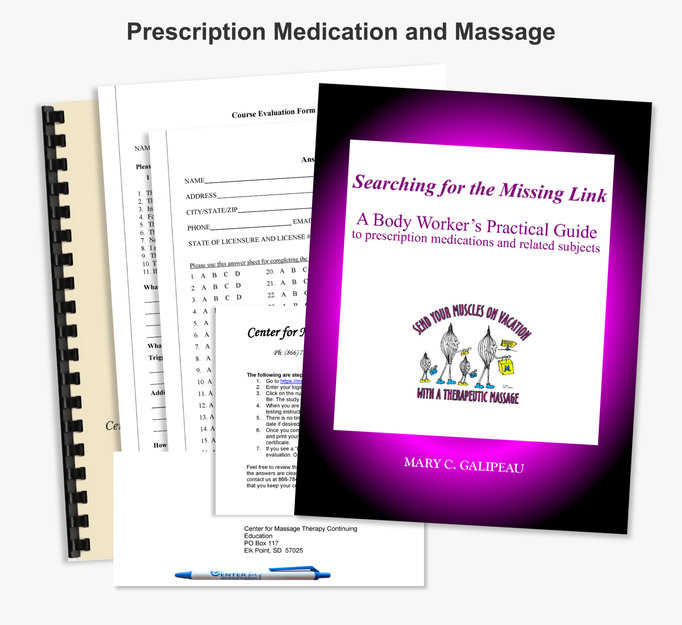
Cost includes all materials. Shipping, if applicable, is a flat rate.
Learn how prescription and over-the-counter medications may affect massage therapy in this 8-hour continuing education course. Prescription Medication and Massage introduces massage therapists to common medications and herbs, drug classifications, potential side effects, and important precautions when working with clients who take medications.
The course provides practical charts and reference information covering massage strokes, heat, pressure, and positioning considerations for clients using a variety of medications. It is designed to help massage therapists recognize medication-related considerations and make appropriate adjustments to massage sessions.
In this course, you will learn:
How prescription and over-the-counter drugs are regulated
Common medication classifications and their effects
How medications may affect massage therapy
Potential medication side effects and precautions
Massage considerations for clients taking prescription medications
Considerations for over-the-counter medications and herbs
Appropriate adjustments to massage strokes and techniques
Heat, pressure, and positioning considerations
Medication-related precautions and treatment considerations
How to use medication reference charts when planning massage sessions
Why take this course?
Many massage therapy clients take prescription medications, over-the-counter medications, or herbal products, making medication awareness an important part of client safety and professional practice. Understanding potential medication effects can help massage therapists recognize situations that may require adjustments to a massage session.
This 8-hour course provides a practical reference for massage therapists who want to strengthen their knowledge of medications and massage. Detailed charts make it easier to review medication-related side effects, cautions, massage considerations, and positioning or pressure restrictions when working with clients.
Describe how prescription and over-the-counter medications are regulated.
Identify common medication classifications and their potential effects.
Explain how medications may influence massage therapy considerations.
Recognize potential side effects and precautions associated with commonly used medications and herbs.
Identify appropriate massage stroke considerations for different medication classifications.
Describe considerations related to heat, pressure, and positioning.
Apply medication-related safety considerations when planning massage sessions.
Use medication reference information to support informed massage therapy decisions.
Text: Searching for the Missing Link by Mary C. Galipeau, 98 pages
Course guide with instructions
54-question examination
Course evaluation
Certificate of achievement upon completion
Unlimited phone support
The Center for Massage Therapy Continuing Education, LLC is an Approved Provider through the National Certification Board for Therapeutic Massage and Bodywork (NCBTMB); Approved Provider number 409296-00.
Our online massage continuing education courses are also accepted by the American Massage Therapy Association (AMTA), Associated Bodywork and Massage Professionals (ABMP), and most state boards.
For more information on individual state requirements and approvals, please visit our Approvals page and click on your state.
I felt very insightful about the knowledge. I plan to reuse the book many times. - Nkaujsabcuab Thao
Loved the detailed charts on specific medications. - Monica Luna, LMT
Everyone should be aware of medications their clients are taking. - Micha Holton, LMT
Detailed information presented in an easy to use format. I can keep my textbook to reference back to if needed. - Lucas Meyers, LMT
I was surprised at how much I learned and how much medications can affect the outcome of massage therapy. - Tabitha Trowers, LMT
Super helpful. Thank you very much for caring about us. A++++++ - Stella Barragan, LMT
I was impressed with how the information was presented. I found that it was easy to learn from and will also be a valuable resource. - J. Hart
Why is it important to know the dosage of a medication a client is taking?
A. To determine the drug classification of the medication
B. Because a larger dosage might create stronger side effects
C. Because a large dosage is an absolute contraindication to massage
D. To diagnose the condition of a client
Which of the following should be avoided when treating a client taking muscle relaxants?
A. Prone positioning
B. Stretching techniques
C. Supine positioning
D. Any type of massage treatment
Tapotement should be used with caution on a client taking a/an:
A. Appetite suppressants
B. Vasodilators
C. Beta-blockers
D. NSAIDs
Course Author
About the Instructor
Corrine Rubida, BS, LMT
Corrine completed her massage therapy training at Gateway College of Massage Therapy in 1997 and earned a Bachelor of Science degree in Healthcare Administration in 2012. She has been practicing and teaching massage therapy since 1997 and currently holds a massage therapy license in South Dakota. She is also a member of the ABMP. In 2002, Corrine founded the Center for Massage Therapy CE to make professional massage continuing education courses available both online and by mail. Since then, she has developed more than 100 home-study massage continuing education courses and has taught live courses for AMTA and the Gateway College of Massage Therapy.