Cost includes all materials. Shipping, if applicable, is a flat rate.
Learn the fundamentals of Table Thai techniques and passive stretching in this 2-hour continuing education course for massage therapists. The course introduces Thai-inspired techniques that can be performed with clients on the massage table, along with stretching techniques for seated clients.
The course also explains the stretch reflex and three basic types of stretching. Self-stretches for massage therapists are included, providing practical techniques that can be incorporated into a regular massage routine and used as part of therapist self-care.
In this course, you will learn:
The fundamentals of Table Thai techniques
Passive stretching techniques for clients on the massage table
A full-body Table Thai and passive stretch routine
Stretching techniques for seated clients
Self-stretching techniques for massage therapists
The stretch reflex and its role in stretching
Three basic types of stretching
How stretching techniques can be incorporated into a massage routine
Why take this course?
Table Thai and passive stretching can give massage therapists additional techniques for incorporating movement and stretching into massage sessions. The techniques presented can be performed with clients clothed or draped and adapted to different massage settings.
This focused 2-hour course is a good choice for massage therapists who want to add Table Thai and stretching techniques to their existing skill set while also learning practical self-stretches for therapist self-care.
Describe the basic principles of Table Thai techniques.
Identify passive stretching techniques appropriate for clients on the massage table.
Describe a full-body Table Thai and passive stretch routine.
Identify stretching techniques that can be performed with seated clients.
Explain the basic function of the stretch reflex.
Differentiate between three basic types of stretching.
Describe self-stretching techniques that massage therapists can use for personal self-care.
Explain how Table Thai and stretching techniques may be incorporated into a massage therapy routine.
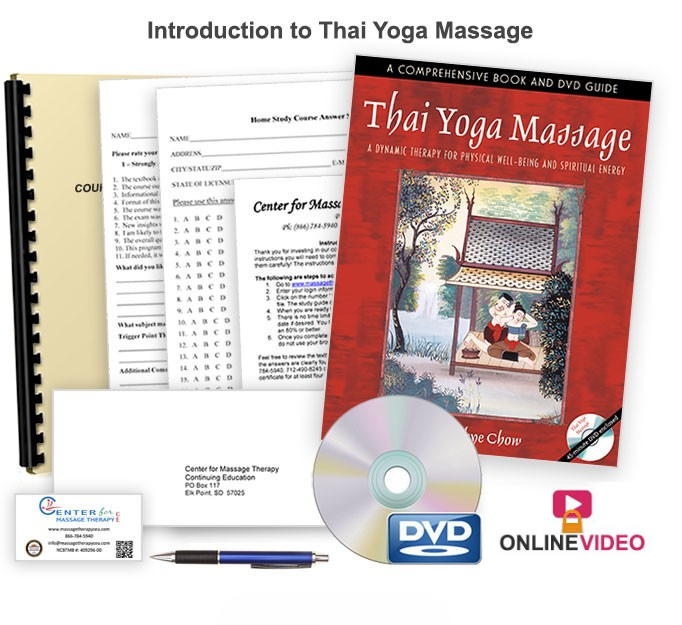
Text: The Passive Stretch Workbook, Table Thai and More for the Client on the Massage Table by Kay Rynerson, LMP, RTT, 56 pages
Course guide with instructions
18-question multiple-choice examination
Course evaluation
Certificate of achievement upon completion
Unlimited phone and email support for any questions
The Center for Massage Therapy Continuing Education, LLC is an Approved Provider through the National Certification Board for Therapeutic Massage and Bodywork (NCBTMB); Approved Provider number 409296-00.
Our massage online continuing education courses are also accepted by the American Massage Therapy Association (AMTA), Associated Bodywork and Massage Professionals (ABMP), and most state boards.
For more information on individual state requirements and approvals, please visit our Approvals page and click on your state.
I found the descriptions surprisingly useful. In the past most online courses I've taken utilized videos. I wasn't sure if I might have difficulty being able to utilize the information in this one as it was a single image for each stretch. However I feel confident about utilizing a lot of information from this course. I also liked the infomation on the stretch reflex and saltwater taffy method which I can easily apply to other stretches I know. - Shannon Clark
I liked that the material could be downloaded - quick and easy. The diagrams/pictures were clear and movements easy to replicate. - Krystal D.
All the stretches were described well and easily understood. - Teresa Lirussi
I LOVED the stretches presented. They were well decribed and easily incorporated into my existing massage routine. - S. City
The website is easy to use and the course material was excellent. - Jayme Black
I love the way the website is set up for online use. The course was easy to download and the information can be used in practice immediately. - Rachel Buss
Excellent reference material. The illustrations are top quality and will be useful when preparing for actually performing some procedures. - B. Price
What is the basic function of the stretch reflex?
A. To monitor the tension needed for posture and movement, and to protect the body from injury
B. To monitor the relaxation needed for posture and movement, and to protect the body from injury
C. To monitor the tension needed for posture and movement, and to protect the body from infection
D. To monitor the relaxation needed for posture and movement, and to protect the body from infection
Where are the practitioner’s hands placed in the ‘57. SWITCHBLADE’ stretch?
A. The south hand on the client’s bent knee and the north hand on top of the toes
B. The north hand on the client’s straight knee and the south hand on top of the toes
C. The north hand on the client’s bent knee and the south hand on the bottom of the foot
D. The north hand on the client’s bent knee and the south hand on top of the toes
‘129. HALF A HUG’ stretches the:
A. Posterior deltoids and the upper back
B. Anterior deltoids and the upper back
C. Posterior deltoids and the lower back
D. Anterior deltoids and the lower back
Course Author
About the Instructor
Kay Rynerson, LMT, RTT
Kay Rynerson, Licensed Massage Practitioner and Registered Thai Therapist and author of The Thai Massage Workbook has been collecting, adapting, and road testing stretches for the client on the massage table since 1988. A graduate of Seattle Massage School, she also earned a teaching certificate from the Institute of Thai Massage in Chiang Mai, Thailand. She maintains a private practice in Seattle, Washington, and teaches nationwide. Member, AMTA and the Thai Healing Alliance International.