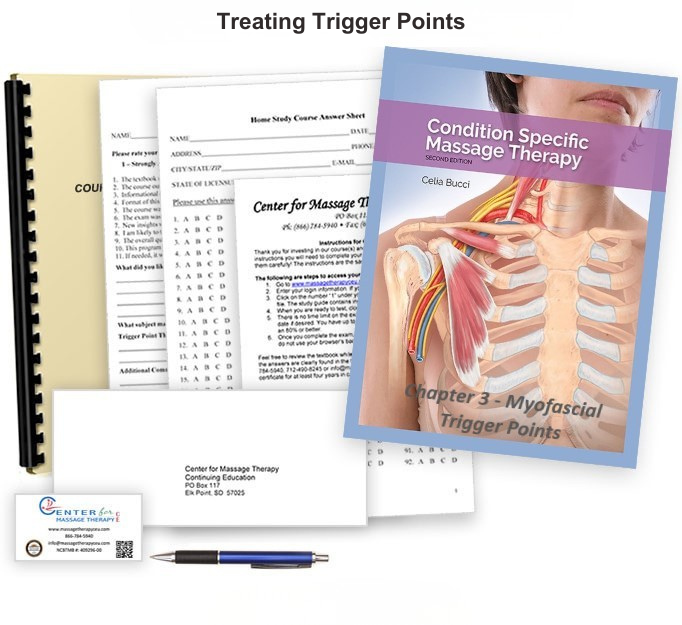
Cost includes all materials. Shipping, if applicable, is a flat rate.
Learn about thoracic outlet syndrome and massage therapy considerations for clients experiencing related symptoms. This 1-hour continuing education course introduces massage therapists to the structures involved, signs and symptoms, contributing factors, contraindications, and client assessment strategies.
The course also covers massage techniques for thoracic outlet syndrome and contributing trigger points, along with range-of-motion testing and client stretching and strengthening strategies.
In this course, you will learn:
What thoracic outlet syndrome is and the structures involved
Common signs, symptoms, and contributing factors
Contraindications and special considerations
Client assessment questions and range-of-motion testing
Massage techniques for thoracic outlet syndrome
Trigger points that may contribute to symptoms
Stretching and strengthening strategies for client self-care
Why take this course?
Thoracic outlet syndrome can involve symptoms affecting the neck, shoulder, and upper extremity, making an understanding of assessment and massage considerations important for massage therapists.
This focused 1-hour course provides practical information on thoracic outlet syndrome, including assessment, contraindications, trigger points, massage techniques, and client self-care strategies.
Describe thoracic outlet syndrome and identify the structures involved.
Identify common signs, symptoms, and contributing factors.
Recognize contraindications and special considerations related to thoracic outlet syndrome.
Describe client assessment questions and range-of-motion testing.
Identify massage techniques appropriate for clients with thoracic outlet syndrome.
Identify trigger points that may contribute to related symptoms.
Describe stretching and strengthening strategies for client self-care.
Text: Thoracic Outlet Syndrome, an excerpt from Condition-Specific Massage by Celia Bucci, 29 pages
Course guide with instructions
9-question multiple-choice examination
Course evaluation
Certificate of achievement upon completion
Unlimited phone and email support for any questions
The Center for Massage Therapy Continuing Education, LLC is an Approved Provider through the National Certification Board for Therapeutic Massage and Bodywork (NCBTMB); Approved Provider number 409296-00.
Our massage online continuing education courses are also accepted by the American Massage Therapy Association (AMTA), Associated Bodywork and Massage Professionals (ABMP), and most state boards.
For more information on individual state requirements and approvals, please visit our Approvals page and click on your state.
Really liked the case study and full protocol for critical thinking. The illustrations for the testing and stretching techniques were a must, as well as the charts and anatomical illustrations. - Stephanie N.
Text was easy to read and follow. - Emily Z.
Easy to navigate and low cost comparison. - Patricia B.
I learned alot from the course info and really enjoyed reading from cover to cover! - Kathy D.
The layout of the course was easy to understand and flowed well from one section to another. - Meghan V.
I learned new information that I did not know before and was able to use techniques right away! - Hillary M.
What is the thoracic outlet?
A. The space between the base of the anterior lateral neck and the axilla
B. The space between the base of the posterior lateral neck and the axilla
C. The space between the base of the anterior lateral neck and the sternum
D. The space between the base of the posterior lateral neck and the vertebrae
Trigger points in the sternocleidomastoid (SCM) may cause:
A. Burning and numbness down the center of the sternum
B. Vertigo, nausea, or ringing in the ears
C. Pain and numbness down the posterior arm
D. Ear and sinus infections
Client self-care for thoracic outlet syndrome should include stretching of which of the following muscles?
A. Scalenes
B. Middle trapezius
C. Rhomboids
D. Pronator teres
Course Author
About the Instructor
Celia Bucci, LMT
Celia graduated from the Soma Institute for Clinical Massage Therapy in 2002. Her continuing education has focused on learning what contributes to common pain complaints, methods for reducing pain and improving movement, and the research supporting both. She’s taught in entry-level massage therapy schools and continuing education programs. She wrote Condition Specific Massage Therapy for massage therapists interested in learning to apply basic techniques to address the specific symptoms of conditions such as headaches, neck, shoulder, low back, hip and knee pain, carpal tunnel syndrome, plantar fasciitis, sprains, muscle strain and tendinitis. The book is used in Massage Therapy schools across the country and is available in Japanese and Korean. Celia has received the 2010 AMTA-IL Distinguished Service Award and the 2012 AMTA-IL Meritorious Award.