Back to All Courses

Trigger Point Therapy

Trigger Point Therapy
18 CE Hours
$199.00

Cost includes all materials. Shipping, if applicable, is a flat rate.


Develop a deeper understanding of trigger point therapy in this 18-hour continuing education course for massage therapists. The course explores myofascial trigger points, muscular anatomy, pain and referral patterns, trigger point charts, and palpation techniques for locating trigger points.

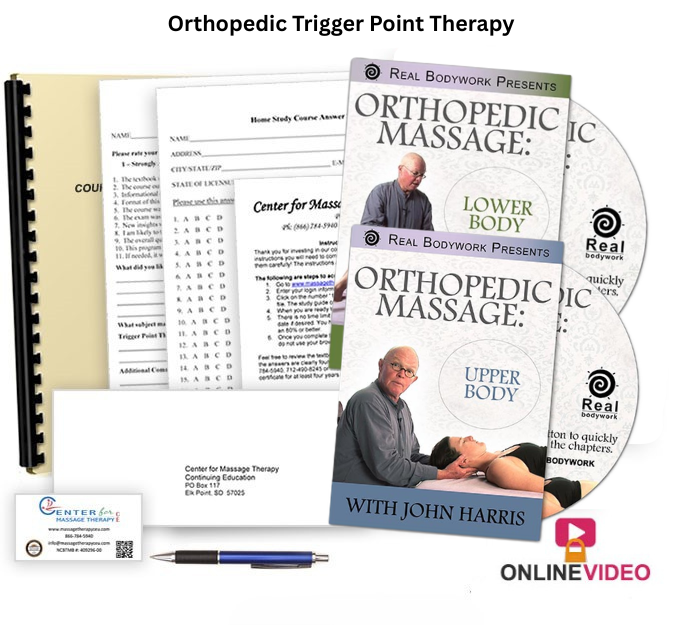
The course also covers stretching and strengthening exercises for individual muscles and includes approximately 2½ hours of online video instruction demonstrating trigger point therapy techniques. Detailed charts and anatomy information provide useful reference material for understanding trigger points throughout the body.

In this course, you will learn:

  • The principles and fundamentals of trigger point therapy
  • Myofascial trigger points and their characteristics
  • Muscular anatomy, including origins, insertions, and actions
  • Trigger point charts for individual muscles
  • Pain and referral patterns associated with trigger points
  • General palpation techniques for locating trigger points
  • Trigger point therapy techniques and applications
  • Stretching and strengthening exercises for individual muscles
  • How trigger point information can be incorporated into massage therapy
  • Practical techniques demonstrated through approximately 2½ hours of online video

Why take this course?

Trigger points and referred pain patterns are important concepts for massage therapists who want to develop stronger assessment and treatment skills. A detailed understanding of muscle anatomy, trigger point locations, and palpation can provide valuable information when working with clients experiencing muscular discomfort.

This 18-hour course provides a comprehensive introduction to trigger point therapy, combining detailed muscle charts and anatomy information with practical technique instruction. It is a good choice for massage therapists who want to develop a deeper knowledge of trigger points and incorporate trigger point techniques into their massage practice.

  • Define myofascial trigger points and describe their characteristics.
  • Identify the major muscles and anatomical structures associated with trigger points.
  • Describe muscle origins, insertions, and actions relevant to trigger point therapy.
  • Identify common trigger point locations using muscle charts.
  • Describe pain and referral patterns associated with individual muscles.
  • Explain general palpation techniques used to locate trigger points.
  • Identify massage techniques and approaches used in trigger point therapy.
  • Describe stretching and strengthening exercises associated with individual muscles.
  • Explain how trigger point assessment and techniques may be incorporated into massage therapy.
  • Demonstrate an understanding of the techniques presented through the online video instruction.
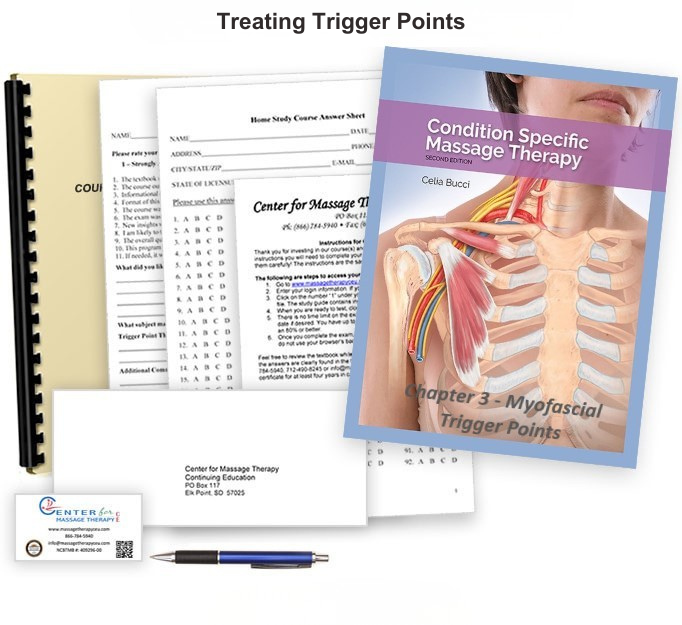
  • Text: Trigger Point Therapy for Myofascial Pain by Donna Finando and Steven Finando, 256 pages
  • Video: Approximately 2½ hours of online video instruction
  • Course guide with instructions
  • 96-question multiple-choice examination
  • Course evaluation
  • Certificate of achievement upon completion
  • Unlimited phone and email support for any questions

The Center for Massage Therapy Continuing Education, LLC is an Approved Provider through the National Certification Board for Therapeutic Massage and Bodywork (NCBTMB); Approved Provider number 409296-00.

Our continuing education courses are also accepted by the American Massage Therapy Association (AMTA), Associated Bodywork and Massage Professionals (ABMP), and most state boards.

For more information on individual state requirements and approvals, please visit our Approvals page and click on your state.

I've purchased a few of your courses and have found them to be great resources for my practice. Your courses have been easy to follow and very interesting to me. - C. Williams, LMT

I like having the book for reference even after taking the online exam. - Amy Brunstetter, LMT

I liked that I could do it on my own time. As long as you read the textbook, you could answer the test questions easily. - Carolyn Ure, LMT

I liked that I had to read the book in order to take the class. I am in grad school for acupuncture so it was a great review for me with eastern medicine. - M. Chiappone

Trigger points are generally located in which of the following muscle types?
A.    Cardiac
B.    Visceral
C.    Skeletal
D.    All of the above

Which of the following modalities can be used by a qualified practitioner to reduce a trigger point?
A.    Acupuncture
B.    Ischemic compression
C.    Spray-and-stretch techniques
D.    All of the above

The pectineus muscle contains how many common trigger points?
A.    1
B.    2
C.    5
D.    6

Course Authors

About the Instructors

Donna and Steve Finando

Donna and Steve Finando have been practicing together since 1975. They have collaborated on books, journal articles, teaching and studying. They were fortunate to study with Janet Travell M.D., who was the White House physician to Presidents Kennedy and Johnson, and the preeminent expert on myofascial pain syndromes. The Finandos have taught internationally, and their best-selling books have been translated into numerous languages. Their approach to treatment is the result of many years of experience and ongoing study.

Donna Finando, M.S. L.Ac., L.M.T began her career as a practitioner of AmmaTherapy and became licensed in massage. She was co-author of the first text on that subject. She evolved her practice into myofascial meridian therapy and later became a licensed acupuncturist as well. She has taught and consulted for both acupuncture and massage colleges and is sought internationally as a teacher. She also maintains a sub-specialty in pediatrics. Donna taught Hatha Yoga for over thirty years and now devotes herself to training in ballet, which she began as a child.

Steve Finando, Ph.D., L.Ac. was a pioneer in the American acupuncture profession. He was a founder and chair of the first national certification commission for acupuncturists (NCCAOM) and later elected as a commissioner and chair of the national accreditation commission for schools and colleges of acupuncture and oriental medicine (ACAOM). He was voted the first Acupuncturist of the Year by the national acupuncture professional association. He has served as a consultant to several acupuncture colleges as well as state acupuncture boards. He has served on the faculty of acupuncture colleges, and helped guide the development of college curricula. He has studied and trained in the martial arts since 1965, holds a second dan black belt in Tang Soo Do (karate) and has taught Tai Qi Chuan and Qi Gong since 1975.

View qualifications
Corrine Rubida

Corrine Rubida, BS, LMT

Corrine completed her massage therapy training at Gateway College of Massage Therapy in 1997 and earned a Bachelor of Science degree in Healthcare Administration in 2012. She has been practicing and teaching massage therapy since 1997 and currently holds a massage therapy license in South Dakota. She is also a member of the ABMP. In 2002, Corrine founded the Center for Massage Therapy CE to make professional massage continuing education courses available both online and by mail. Since then, she has developed more than 100 home-study massage continuing education courses and has taught live courses for AMTA and the Gateway College of Massage Therapy.