Cost includes all materials. Shipping, if applicable, is a flat rate.
Ethical and professional business practices are an important part of building a successful massage therapy practice. Massage therapists must not only provide appropriate client care, but also understand informed consent, disclosure, business policies, professional relationships, and their responsibilities when working with other healthcare professionals.
This 4 CE hour course provides massage therapists with practical information about ethical business practices and professional relationships. You’ll explore informed consent, disclosure of information, working with other healthcare professionals, developing business policies and procedures, and important differences between working as an independent contractor and an employee.
The course is designed to help massage therapists make informed professional decisions, establish clear business practices, and develop productive relationships with clients, colleagues, and other professionals.
In this course, you will learn:
What disclosure means and the different perspectives surrounding disclosure
Guidelines for appropriately handling the disclosure of information
The importance of informed consent for both therapists and clients
How to develop professional relationships with other healthcare professionals
Strategies for improving communication and collaboration with other professionals
How to create effective policies and procedures for your massage practice
Important professional and ethical considerations when operating a massage practice
The differences between an independent contractor and an employee
How business structure and professional responsibilities can affect your work
Why take this course?
Running a massage therapy practice involves much more than providing massage services. Understanding the ethical and business responsibilities that come with being a massage therapist can help you establish clear expectations, protect your practice, and build professional relationships.
Whether you own your own massage practice, work as an employee, or provide services as an independent contractor, this course provides practical information you can apply to your professional career.
Explain the meaning of disclosure and appropriate methods for handling professional information.
Describe the importance of informed consent in massage therapy practice.
Identify strategies for developing productive relationships with healthcare professionals.
Apply effective communication and collaboration strategies when working with other professionals.
Explain the purpose and importance of policies and procedures in a massage therapy practice.
Identify ethical and professional considerations involved in operating a massage business.
Describe the differences between working as an employee and an independent contractor.
Apply ethical and professional principles to common business and workplace situations.
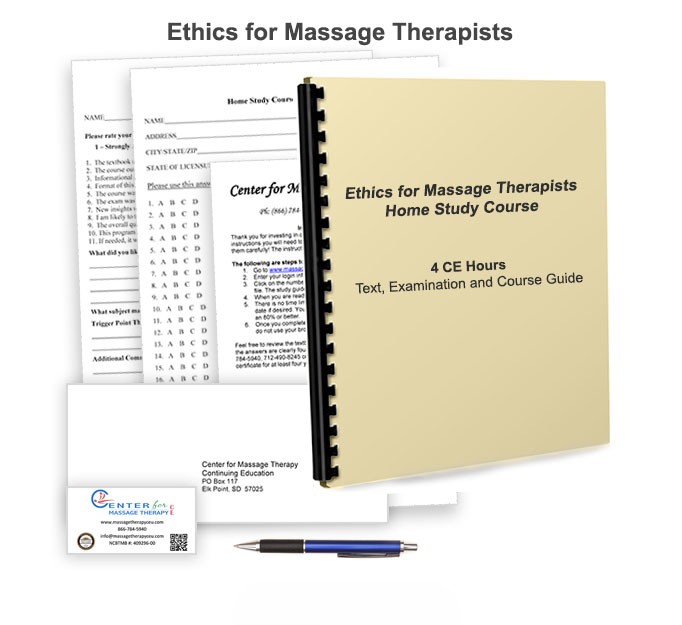
Text: Ethics for Massage Therapists text, Chapters 8-11 by Terrie Yardley Nohr, 66 pages
Guide with instructions
Multiple choice exam of 20 questions
Course evaluation
Certificate of achievement upon completion
Unlimited phone and email support for any of your questions
The Center for Massage Therapy Continuing Education, LLC is an Approved Provider through the National Certification Board for Therapeutic Massage and Bodywork (NCBTMB); Approved Provider number 409296-00.
Our continuing education courses are also accepted by the American Massage Therapy Association (AMTA), Associated Bodywork and Massage Professionals (ABMP), and most state boards.
For more information on individual state requirements and approvals, please visit our Approvals page and click on your state.
It was straighforward and transparent. It provided insight and relevant information that is useful personally and professionally. - Robert P.
The course kept my interest because it was progessive in nature by building one concept upon the last. Easy to follow. - E. Sistrunk
Easy to understand Business Ethics, the importance of having policies and procedures for both clients and employees. - T. Jordan
Easy and common sense. Wasn't sure about online testing (never did it before) but I really liked it! - Richelle G.
What is disclosure?
a. Giving information about a client to an outside person
b. Revealing information to another person about oneself or another person
c. A situation that occurs when two roles or relationships overlap or interact
d. Beliefs about what is right and wrong or good and bad
All of the following may be included in a policy and procedure manual EXCEPT:
a. Employee policies and procedures such as hiring, dress code, and scheduling
b. Tax documents such as 1099’s of prior employees and form 1040
c. Client policies such as customer service and scheduling
d. Facility procedures such as opening and closing procedures
What is an independent contractor?
a. A non-employee who provides services within a business
b. A person who owns and operates his or her own business and often works alone
c. An employee who provides services within a business
d. A partnership in which two people own and operate a business equally
Course Author
About the Instructor
Terrie Yardley-Nohr, LMT
Terrie Yardley-Nohr, LMT, is the Director of Massage Therapy at MassageLuXe and has more than three decades of experience in the massage industry. Yardley-Nohr has worked in various massage settings, including private practices, retail spas and chiropractic offices. Her extensive knowledge and expertise have enabled her to develop programs and curriculums for several career colleges. Nohr’s book, “Ethics for Massage Therapists,” is a standard reference used by educators to train aspiring massage therapists. She has also served on the boards of the American Massage Therapy Association and the Alliance of Massage Therapy Educators, where she played a significant role in the passage of a law mandating state licensure and testing for massage therapists.