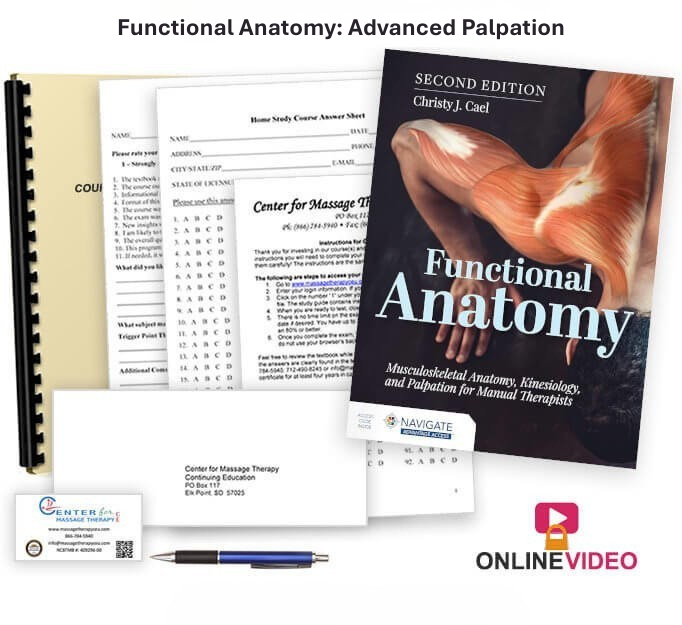
Cost includes all materials. Shipping, if applicable, is a flat rate.
Strengthen your understanding of musculoskeletal anatomy and physiology in this 14-hour continuing education course for massage therapists. The course provides an in-depth review of more than 150 major muscles of the body, including their origins, insertions, actions, and nerve activation.
In addition to muscle anatomy, the course explores anatomical directions, body movements, planes of movement, muscle contraction types, and group actions of muscles. It also examines common problems and disorders associated with muscles, along with stretching and strengthening exercises that relate to muscle function.
Designed as an advanced anatomy and physiology course, this is an excellent choice for massage therapists who want to refresh their knowledge of the musculoskeletal system and develop a stronger understanding of how muscles function and move.
In this course, you will learn:
The anatomy and physiology of more than 150 major muscles
Muscle origins, insertions, actions, and nerve activation
Anatomical directions, planes of movement, and body movements
Different types of muscle contractions and group muscle actions
How muscles function in relation to movement
Common problems and disorders associated with muscles
Stretching and strengthening exercises for major muscle groups
Visual muscle diagrams and anatomical reference information
Why take this course?
A strong understanding of anatomy and physiology is essential to massage therapy practice. This 14-hour course provides a detailed review of more than 150 muscles and their structure, function, movement, and nerve activation, making it a valuable choice for therapists who want to strengthen or refresh their musculoskeletal anatomy knowledge.
Identify the major anatomical structures and muscles covered in the course.
Describe the origin, insertion, action, and nerve activation of major muscles.
Explain anatomical directions, planes of movement, and basic body movements.
Describe different types of muscle contractions and group actions.
Explain the relationship between muscle structure and function.
Identify common problems and disorders associated with muscles.
Describe appropriate stretching and strengthening exercises for major muscle groups.
Apply knowledge of musculoskeletal anatomy and physiology to strengthen professional massage therapy knowledge.
Text: The Concise Book of Muscles, 4th Edition, by Chris Jarmey and John Sharkey, 288 pages
Study guide with instructions
72-question online multiple-choice exam
Course evaluation
Certificate of achievement upon completion
Unlimited phone support
The Center for Massage Therapy Continuing Education, LLC is an Approved Provider through the National Certification Board for Therapeutic Massage and Bodywork (NCBTMB); Approved Provider number 409296-00.
Our online massage continuing education courses are also accepted by the American Massage Therapy Association (AMTA), Associated Bodywork and Massage Professionals (ABMP), and most state boards.
For more information on individual state requirements and approvals, please visit our Approvals page and click on your state.
Love the book. It's a clearly detailed and super definitive text on the skeletal muscles. The test is comprehensive and informative. - J S Kaufman
Excellent, excellent, excellent. Now I can renew my Montana State Massage Therapy license. Thanks so much, and keep up the good work! - Eric Mitchell, LMT
Wonderful refresher course of what I learned in school. - D. Yockey, LMT
I liked to good visuals along with the additional information that can be easily applied to massage such as common problems if the muscle is tight and exercises for stretching and strengthening the muscle. - Melissa Green, LMT
Received book in timely manner. - Catherine Dale, LMT
What three muscle groups comprise the transversospinalis?
A. Erector spinae, semispinalis and splenius capitis
B. Splenius capitis, splenius cervicis and rotatores
C. Semispinalis, multifidis and rotatores
D. Semispinalis, splenius capitis and splenius cervicis
All of the following are strengthening exercises for the muscles of the subscapularis EXCEPT:
A. Shoulder medial rotation with resistance band
B. Shoulder medial rotation with weights
C. Isometric shoulder medial rotation
D. Lateral rotation arm stretch
Continued wearing of heigh-heeled shoes may cause shortening of what muscle?
A. Popliteus
B. Soleus
C. Tibialis anterior
D. Plantaris
Course Author
About the Instructor
Corrine Rubida, BS, LMT
Corrine completed her massage therapy training at Gateway College of Massage Therapy in 1997 and earned a Bachelor of Science degree in Healthcare Administration in 2012. She has been practicing and teaching massage therapy since 1997 and currently holds a massage therapy license in South Dakota. She is also a member of the ABMP. In 2002, Corrine founded the Center for Massage Therapy CE to make professional massage continuing education courses available both online and by mail. Since then, she has developed more than 100 home-study massage continuing education courses and has taught live courses for AMTA and the Gateway College of Massage Therapy.