Cost includes all materials. Shipping, if applicable, is a flat rate.
Learn the principles and practical application of positional release techniques in this 21-hour advanced continuing education course for massage therapists. Positional release uses positioning and gentle techniques to address muscle and fascial restrictions while keeping the body in a position of ease.
The course explores several positional release methods, including strain/counterstrain, functional technique, facilitated positional release, the McKenzie method, and taping. It also covers step-by-step technique applications, indications, cautions, research evidence, and considerations for working with acute and chronic conditions, spinal problems, and bed-ridden clients. Online technique demonstrations provide additional visual instruction.
In this course, you will learn:
The principles and foundations of positional release techniques
Strain/counterstrain and other positional release methods
Functional and facilitated positional release techniques
McKenzie methods and taping applications
Step-by-step application of positional release techniques
Indications, contraindications, cautions, and safety considerations
Positional release applications for acute and chronic conditions
Considerations for spinal problems and bed-ridden clients
Research evidence related to positional release methods
Practical techniques demonstrated through online video presentations
Why take this course?
Positional release techniques can be a valuable addition to a massage therapist's skill set. This 21-hour advanced course provides broad coverage of several positional release approaches while combining detailed written instruction, research information, and online technique demonstrations.
Describe the principles and theory behind positional release techniques.
Identify major positional release methods and their applications.
Explain the principles of strain/counterstrain, functional technique, and facilitated positional release.
Describe the use of the McKenzie method and taping within positional release approaches.
Demonstrate an understanding of step-by-step positional release applications.
Identify indications, contraindications, cautions, and safety considerations.
Describe positional release considerations for acute and chronic conditions and special populations.
Discuss research evidence related to positional release techniques.
Apply positional release concepts appropriately within massage therapy practice.
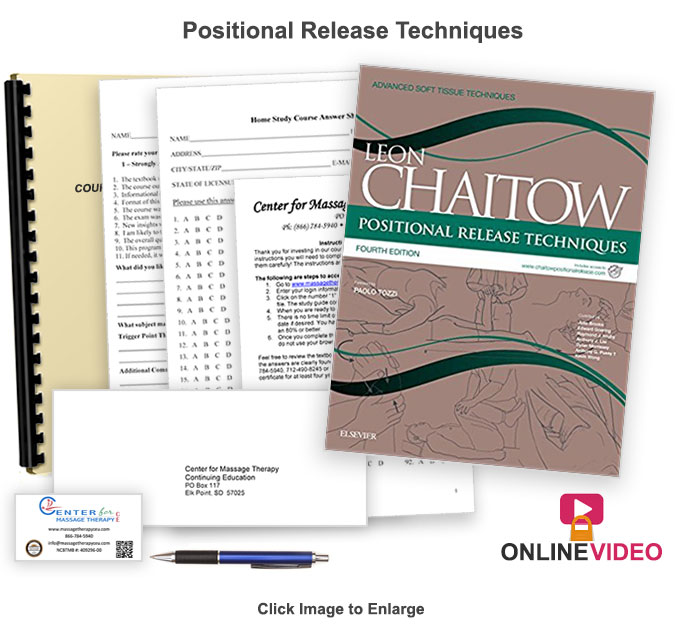
Text: Positional Release Techniques, 4th Edition by Leon Chaitow, 272 pages
Video: Online technique demonstrations
Course guide with instructions
105-question examination
Course evaluation
Certificate of achievement upon completion
Unlimited phone support
The Center for Massage Therapy Continuing Education, LLC is an Approved Provider through the National Certification Board for Therapeutic Massage and Bodywork (NCBTMB); Approved Provider number 409296-00.
Our online massage continuing education courses are also accepted by the American Massage Therapy Association (AMTA), Associated Bodywork and Massage Professionals (ABMP), and most state boards.
For more information on individual state requirements and approvals, please visit our Approvals page and click on your state.
It was very challenging to read everything, but helpful to watch the videos. It was relatively easy to take the exam while reviewing the reading material. - Laurie S.
I loved all the information. Just a ton of information. I would never have gotten this much information out of a live training. The exam was extremely challenging. This was a very intense, long, course. It was exhausting and I would have enjoyed more fun information. But as far as providing research based information, this was an outstanding course. - M. Bogle
To the point and strait forward and received info fast. - M. Dixon, LMT
I learned concepts that I can incorporate into my massage practice. - Charlene Taylor Gray, LMT
For a home study course, it contained a ton of valuable information. I especially liked the research that backed up each positional release method. - Phil Madison, LMT
What is the best known and most widely used positional release variation?
A. Osteopathic functional technique (FuPR)
B. Facilitated positional release (FPR)
C. Strain counterstrain (SCS)
D. McKenzie’s method
All of the following are ideal settings for application of SCS/PRT EXCEPT:
A. For reduction of stiffness (hypertonia) in pre- and postoperative patients
B. In cases of acute and multiple strain – whiplash, for example
C. In cases of recent major trauma or surgery
D. In treatment of sensitive, frail, delicate individuals or sites
Which of the following is an essential difference between SCS and functional technique?
A. In SCS, there is no reliance on feedback from the patient as to reduction in pain during the process of positioning and fine-tuning
B. In functional work, there is no reliance on feedback from the patient as to reduction in pain during the process of positioning and fine-tuning
C. In functional work, tissues are not placed into a position of ease, but rather stretched to the maximum range of motion
D. In SCS, tissues are not placed into a position of ease, but rather stretched to the maximum range of motion
Course Author
About the Instructor
Corrine Rubida, BS, LMT
Corrine completed her massage therapy training at Gateway College of Massage Therapy in 1997 and earned a Bachelor of Science degree in Healthcare Administration in 2012. She has been practicing and teaching massage therapy since 1997 and currently holds a massage therapy license in South Dakota. She is also a member of the ABMP. In 2002, Corrine founded the Center for Massage Therapy CE to make professional massage continuing education courses available both online and by mail. Since then, she has developed more than 100 home-study massage continuing education courses and has taught live courses for AMTA and the Gateway College of Massage Therapy.