Back to All Courses

Professional Ethics

Professional Ethics
6 CE Hours
$69.00

Cost includes all materials. Shipping, if applicable, is a flat rate.


Strengthen your understanding of professional ethics in massage therapy in this 6-hour continuing education course. Professional Ethics introduces massage therapists to professionalism, ethical decision-making, roles and boundaries, and the responsibilities involved in maintaining professional client relationships.

The course also explores ethical boundaries and limitations, sexual boundaries, financial boundaries, and ethical business practices. It provides practical information to help massage therapists understand and apply professional ethics in everyday massage therapy practice.

In this course, you will learn:

  • The principles of professional ethics in massage therapy
  • Professional roles and responsibilities
  • Appropriate roles and boundaries for massage therapists
  • Ethical boundaries and professional limitations
  • Sexual boundaries and professional conduct
  • Financial boundaries and ethical business practices
  • Frameworks for establishing ethical massage therapy practices
  • Ethical considerations in client relationships
  • How professionalism supports a successful massage therapy practice

Why take this course?

Professional ethics are an essential part of massage therapy practice. Understanding boundaries, professional responsibilities, and ethical business practices can help massage therapists maintain appropriate relationships with clients and make sound professional decisions.

This 6-hour course is a good choice for massage therapists who want a comprehensive review of professional ethics, including roles and boundaries, sexual boundaries, and financial considerations. It can also provide continuing education related to ethics requirements for license renewal.

  • Define professional ethics and explain their importance in massage therapy.
  • Identify appropriate professional roles and boundaries.
  • Recognize ethical boundaries and limitations within massage therapy practice.
  • Describe appropriate sexual boundaries and professional conduct.
  • Identify ethical considerations related to financial relationships and business practices.
  • Explain how professional frameworks can support ethical massage therapy practice.
  • Apply ethical principles to client relationships and professional situations.
  • Recognize the importance of professionalism in massage therapy practice.
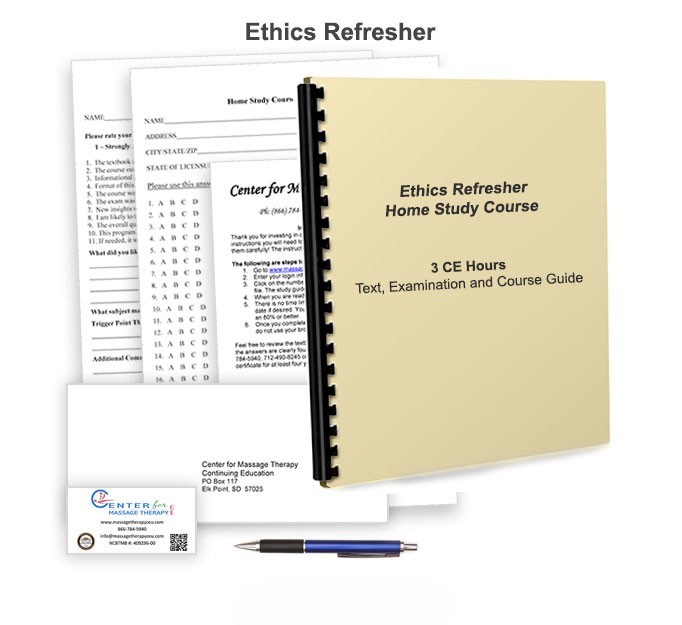
  • Text: The Educated Heart, 6th Edition, by Laura Allen, 249 pages
  • Guide with instructions
  • Multiple choice exam of 40 questions
  • Course evaluation
  • Certificate of achievement upon completion
  • Unlimited phone and email support for any of your questions

The Center for Massage Therapy Continuing Education, LLC is an Approved Provider through the National Certification Board for Therapeutic Massage and Bodywork (NCBTMB); Approved Provider number 409296-00.

Our continuing education courses are also accepted by the American Massage Therapy Association (AMTA), Associated Bodywork and Massage Professionals (ABMP), and most state boards.

For more information on individual state requirements and approvals, please visit our Approvals page and click on your state.

It was very straight forward and I love the study guide! Nice touch. - S. Warren, LMT

I liked the customer care line. I had questions and they were a great help. - J. Schwede, LMT

It shed light on the topic of ethics. Great course for massage therapists. - Nathan Childs, LMT

Easy to read and apply new information. - H. Sorensen, LMT

It was very comprehensive. - Mary Batt, LMT

Which of the following terms is defined as knowing what you have a right to do and what is right to do?
A. Logic
B. Ethics
C. Boundaries
D. Therapeutic relationship

Which of the following should be avoided when naming your massage therapy business?
A. Choosing a name that conveys the impression you are hoping to give
B. Using words that some people may not know the meaning of
C. Having the therapist's name in the business name
D. Choosing a name because it has sentimental significance to you

Psychological theory calls the process of how clients react to the power imbalance as ________.
A. Conduct
B. Framework
C. Transference
D. Countertransference

Which of the following is NOT a good way to become more secure with financial dealings?
A. Hiring a coach who is not a business owner but has taken a course in coaching
B. Examine your own attitudes about money
C. Attend a peer group discussion
D. Hiring a mentor who is comfortable in their relationship with finances and business issues

Course Author

About the Instructor

Laura Allen

Laura Allen, LMT

Laura Allen, BA, NCLMBT#1042, is the President of Sales & Marketing at CryoDerm, a family-owned company located in Margate, FL that makes plant-based Pain Relief and Therapeutic Massage products. She is also on the team of CryoDerm Educators.

A graduate of Shaw University and The Whole You School of Massage Therapy, Allen began her studies of bodywork in 1993, and has been a licensed massage therapist since 2000. From 1998-2003, she was the administrator and an instructor at The Whole You. From 2003-2016, she owned THERA-SSAGE, a multi-disciplinary clinic offering chiropractic, massage therapy, acupuncture, esthetics, naturopathy, and nutritional counseling. Allen has been an Approved Provider of Continuing Education under the NCBTMB since 2002, offering classes in professional ethics, research literacy, business and marketing, massage therapy techniques, and training for those who want to be instructors of massage therapy. She has taught classes all over the US, in Canada, and the UK.

Allen is the author of numerous books, including Nina McIntosh’s The Educated Heart 6th ed, Plain & Simple Guide to Therapeutic Massage & Bodywork Examinations 5thed, One Year to a Successful Massage Therapy Practice 2nd ed, A Holistic Practitioner’s Guide to Business, and many others.

View qualifications